Something’s Coming: Part 2

Here’s the second installment of a series of blog posts from the journal I kept discerning grad school.  When I was going through this process, I talked to my trusted friends and consulted a number of blogs of complete strangers just to gather as much information as possible.  Are YOU thinking about a MFA in acting?  Go to my Connect page and drop me a comment.  I would love to talk to you.  You can also follow this blog from that page.
MBUDrowsy-0711

Oct. 2, 2013

My friend Joy has been sitting on my shoulder for a year now.  After West Side Story one night, she pulled me aside and–completely out of the blue–said, “You need to go get your MFA in acting.”  It was a sincere comment, and I took it to heart almost immediately.  Aside from being a trusted friend, I respect her and her work immensely.  I didn’t take it lightly that she was giving me unsolicited advice and that she was telling me something I had been pondering for a while now.  But could I do it?

This sounds a bit melodramatic, but that’s because it’s important to me to weigh my options and seek the opinions of those who I trust.  I need as much help as possible to process all of this.

Sometimes it’s hard for me to say what I truly want, but I am realizing that an MFA is what I want.  All the work I need to make that happen and the leap of faith that I will need to leave my current life is quite scary.

I am going to pursue this.

I had a great talk with Joy at last night’s Drowsy Chaperone rehearsal.  I basically spilled my guts.  I told her that I think it’s time, and that all arrows seem to be pointing towards this big life change.  She responded:  “I can tell!”

Comment from my 2014 self:  Even though this was a short journal entry, it held three important ideas.  First of all, I actually made a decision and then stated what I wanted.  I didn’t know how it was going to happen, but it was worthwhile for me to state that I wanted something in my life to be different.  It’s an important step to take if you actually want something in your life to be different.  Secondly, I was already using words like “trust” and “faith.”  Things have a way of working out for the best.  Take heart in that.  Lastly, talk to someone.  Talk to anyone.  Maybe what you want isn’t so earth-shattering.  And maybe people are willing to help you achieve it.
Something’s Coming:  Part 1

The first rule about Manifesto Fight Club…

Don’t talk about Manifesto Fight Club

WP_20141009_015

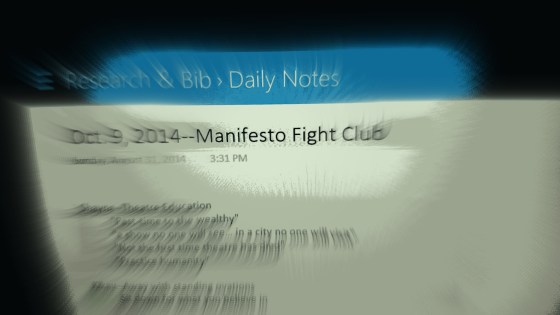
Yes, this really was the heading to my notes today from Research & Bibliography.  As an exercise in passionate thinking, our writing professor–DJ–fashioned a study of famous manifestos for us to read last week, and this week we were to return with a manifesto of our own in hand.  At first glance, it seemed like the assignment was really an invitation and railpass for the crazy train, but I would say–without exception–people were fired up to present their manifestos today for the class.  My topic was one of intense passion for me:  fonts.  What follows is a tirade on Comic Sans.

As we learned in our study, manifestos have a certain flair for formatting.  Since WordPress can’t replicate that easily, feel free to view the original document here.  Below is a little taste.

Because fonts matter. Fonts are the well from which you dip the written word.

Give me fonts drawn from a spring-fed pool ladled with a hollowed gourd;

Give me fonts brewed with coffee and served with cream in a ceramic mug;

Give me fonts distilled like smoky scotch poured in a cut-glass lowball.

These fonts enrich me.

Comics Sans is acid rain. Comic Sans is Sweet ‘n’ Low. Comics Sans is an appletini.

Snacks--and whose responsibility it is to bring them--occupies a full page in the syllabus for THEA 600.  The first week, Shane started the trend with bringing juice boxes.  I dutifully carried out the following with Jumex.  Liv, thanks for the Minute Maid this week.

Snacks–and whose responsibility it is to bring them–occupies a full page in the syllabus for THEA 600. The first week, Shane started the trend of bringing juice boxes to accompany the munchies. I dutifully carried out the following with Jumex. Liv, thanks for the Minute Maid this week.

Can the Music of Broadway Reclaim the Top 40?

This week, the MFAs launch their research projects.  Care to weigh in on my proposal?  Know any resources? Comment below.  

The music of Broadway has always been a genre in dialogue with the popular music of the time.  In the early part of the twentieth century, theatre-goers could expect to hear the music they found in theatres broadcast on that new device—radio—and conversely, they thrilled to hear their favorite radio and parlor hits sung live onstage.  In a not-so-distant era of American popular music, the music of Broadway was popular music.

At some point, however, the dialogue that existed between popular music and Broadway music either fizzled or turned one-sided.  Perhaps both genres amiably departed in their natural evolution or perhaps they split sharply.  At various junctures in musical theatre history, Broadway looked to popular music, but popular music seemed to give little regard to Broadway.  Looking to examples such as Hair, A Chorus Line, Rent, and In the Heights, Broadway certainly responded to popular music, as these shows all evoked the musical style particular to the period in which they were created, namely elements of rock ‘n’ roll, disco, pop rock, and hip-hop.  Whether popular music responded to any of the Broadway shows that so clearly sit rooted in popular music becomes harder to identify.

One data-driven indicator of the relationship between Broadway and popular music lies in a Broadway song’s inclusion in the “Top Forty” charts.  The Top Forty serves as the standard measure for song popularity in the United States, and it stands to reason that any Broadway song that made the charts successfully “crossed over” the genre divide.  Though the Top Forty only goes back to 1951, this research will also seek a measureable record of song popularity prior to that date.  This data can then be used to examine the following questions:

  • Did Broadway music slip gradually from the top forty charts or was it a swift fall?
  • Does the data point to any corresponding social or societal shifts such as new technology or world events?
  • Does the data point to any corresponding events in musical theatre history?
  • Can any correlation be drawn to a shift in song form or other musical factors?
  • Do individual performers have more or less success in bringing Broadway music to the pop charts (e.g.-Barbra Streisand)?

In conclusion, this research will aim to describe the relationship between Broadway music and popular music over the past one hundred years and identify certain conditions that might make a Broadway song more or less likely to cross over to the pop charts.  From there, it might be possible to make suppositions about the future relationship of these two genres.  Put another way, can the fluid dialogue that once existed between Broadway and popular music ever be restored?


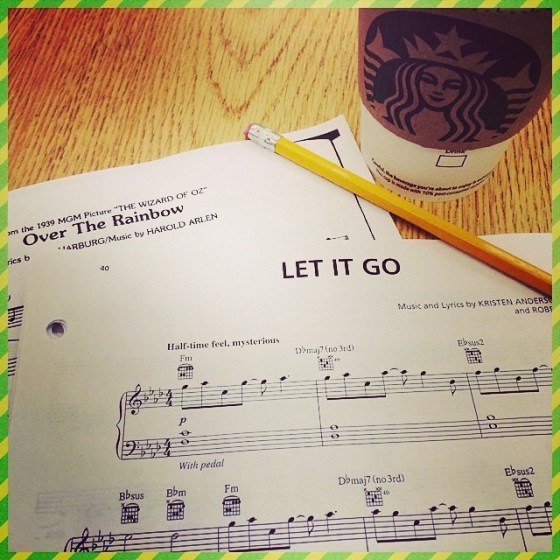
It's hard not to think of "Let It Go".  What does the Frozen hit have that modern show tunes lack? Photo courtesy of: Jacob Brent

It’s hard not to think of “Let It Go”. What does the Frozen hit have that modern show tunes lack?
Photo courtesy of: Jacob Brent

Blog at WordPress.com.