San Diego Premieres Steve Martin’s New Musical

In his program note, Old Globe Artistic Director Barry Edelstein calls Bright Star a “great yarn with a heart as big as a mountain and a soul as deep as the sea.” A “yarn” proves to be an apt description for this show, because the characters in this completely new bluegrass musical weave their story in a lovely, homespun way. The creators set about knitting that story using the Broadway formula, but—doing so without customary Broadway-style flash—the audience discovers they have invested in the story without knowing they have fallen for the usual tricks. After an hour of this knitting, the feeling when the houselights come up for intermission is as if the audience discovered they were suddenly wearing sweaters they hadn’t been donning at the top of the show.
Watching this bit of handiwork on stage is a treat. The work is the Old Globe’s fifth dramatic collaboration with funny man, actor, playwright, banjoist, songwriter Steve Martin over the last two decades, and the theatre has been involved with Bright Star for the past two years. The piece underwent the workshop process in February and March in New York; now, in October, it receives a full and proper stage treatment.
As for the show itself, the story opens on a young veteran making his way home to North Carolina immediately following World War II. A.J. Shively brings an exuberance to the character of the young soldier, Billy Cane. At the outset, Billy appears to be the main protagonist; he sets out to become a writer upon his return to civilian life. His storyline, however, is eclipsed quickly by that of Alice Murphy, his editor. Throughout the show, the story jumps like a handy game of hopscotch between Miss Murphy in 1945 and her younger self in 1923. We enjoy Billy’s story arc, but we actually invest in Miss Murphy’s. Carmen Cusack shines bright as a…well, er—star—in the role of Alice Murphy. Aside from the expected challenges of portraying the same character 22 years apart in back-to-back scenes—which she accomplishes seamlessly—her voice is particularly suited for delivering both the folksy joy as well as the aching melancholy that the bluegrass score demands at different times.
One such moment of aching melancholy is the second act number “I Had a Vision.” Though the score overall is quite tuneful, this number—shared by Miss Cusack and Wayne Alan Wilcox who plays Alice Murphy’s teenage flame, Jimmy Ray Dobbs—is the most poignant song in the show. For anyone in their mid-thirties to mid-forties whose present life is different than their twenty-year old self had planned, this song is especially heart-breaking. By this point in Act II, that same audience who realized they were wearing sweaters look down to discover that somehow the cast has also sewn on buttons and has closed the garment around them.
The garment is plenty comfortable. Steve Martin—as composer and book writer this time—teams with lyricist Edie Brickell to fashion a bluegrass score that is at times straight up Appalachian hoedown (“Whaddya Say, Jimmy Ray” and “Another Round”) and at other times more of a show tune sensibility (“A Man’s Gotta Do” and the aforementioned “I Had a Vision”). The cast generally balances bluegrass and Broadway quite well, aided greatly by the orchestra that includes banjo (of course), guitar, mandolin, and fiddle. While avid musical theatre ears might harken to shows like Smoke on the Mountain, the instrumentation doesn’t seem out of place for a casual theatre-goer who has a Pandora playlist that includes Mumford & Sons. Efforts to resist toe-tapping are worthless.
Putting the orchestra in the frame of a house, director Walter Bobbie involves the musicians in a charming way without being too gimmicky. As scenes shift, the actors wheel that shack around the stage like Dorothy’s house. The audience never questions the band’s onstage presence; they are totally at home in the thick of the action. On the subject of scenery and staging, Bobbie employs the kind of devices that leave the majority of the work to the imagination. With this kind of Our Town-esque responsibility, the director charges the actors to transform chairs and crates into a train in one moment and a star-lit glen in another. The sensibility is a bit more Peter and the Starcatcher than Our Town, but it is of the same lineage. In Bright Star, the production value always bows in deference to the story, which is the right approach in this instance.
As stated before, the possibility that Mr. Martin and Ms. Brickell might tailor this piece further following the San Diego run is an exciting prospect. The creators might consider rounding out Act II with a few additional numbers or judiciously-placed reprises. For example, Miss Murphy’s employees, Daryl Ames and Lucy Grant—played hilariously by Jeff Hiller and Kate Loprest—could stand to have a number in addition to their part in the lackluster expositional number “My Wonderful Career.” Dora—the slightly daffy sister played by Libby Winters—needs more material to connect the events from Act I to her raucous Act II romp, “Another Round.” Lastly, because Act I ends in a kind of lean-forward-in-your-seat, eyes-wide-open manner, Act II opens with the reassuring “Sun’s Gonna Shine” to release the collective tension. But the song speaks with so much hope that it practically begs for a reprise at the end of Act II. Martin and Brickell use a reprise of “I Had a Vision” instead—which is effective and moving—but the moment could benefit from some musical quoting of “Sun’s Gonna Shine.” No doubt, the creators feel they have a complete and streamlined story, and again, in this instance, snappy storytelling is probably the best choice. But the audience—happily on board for the story—would probably permit a few detours.
The Old Globe should be commended for this collaboration with Ms. Brickell and Mr. Martin as well as with director Walter Bobbie, choreographer Josh Rhodes, music director Rob Berman, and the team of designers. They have woven a story that feels good and that hopefully will parade around for awhile before it goes in the cedar chest.
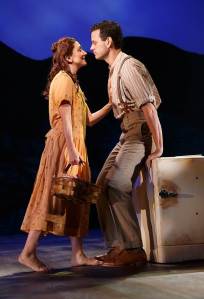
Carmen Cusack as Alice Murphy and Wayne Alan Wilcox as Jimmy Ray Dobbs with the cast of the world premiere of Bright Star, a new American musical with music by Steve Martin and Edie Brickell, lyrics by Brickell, book by Martin, based on an original story by Martin and Brickell, and directed by Tony Award winner Walter Bobbie, Sept. 14 – Nov. 2, 2014 at The Old Globe. Photo by Joan Marcus.
Edited: March 24, 2016

 7 1/2 Cents: Musings on Musical Theatre