La Jolla Playhouse’s ‘Come From Away’ shows heart

September 11, 2001 is widely regarded as this generation’s “JFK Moment” in so far as everyone aware of the unfolding events of that day could probably say exactly where they were when they first heard the tragic news.  But while many people can describe watching the events of September 11, few can describe what they gave in response to the tragedy in such generous terms as the people of Gander, Newfoundland who welcomed 7000 passengers on 38 diverted planes that day.

The story unfolds in rapidly-paced vignettes in the new musical Come From Away, playing at La Jolla Playhouse through July 5 (at least).  The creators—husband-and-wife writing team Irene Sankoff and David Hein—are known to those who know them at all from their first show, My Mother’s Lesbian Jewish Wiccan Wedding, based on David’s mother’s true story.  It seems this team feels that real life stories make the best stories.  And they have real life stories in abundance.

Sankoff and Hein traveled to Newfoundland in September 2011 to take part in the reunion commemorating the 10th anniversary of the 7000 temporary refugees descending on Gander.  They conducted extensive interviews with the “Plane People” as well as the citizens of Gander who opened their doors and their hearts.  These first-person accounts—often delivered to the audience in direct address—along with the folk Irish musical elements—a piece of Newfoundland’s unique cultural history—makes Come From Away equal parts The Laramie Project and Once.

Come From Away is the second show from husband-and-wife creative team Irene Sankoff and David Hein, following their first and also based on a true story success, My Mother's Lesbian Jewish Wiccan Wedding. (Photo courtesy of La Jolla Playhouse)

Come From Away is the second show from husband-and-wife creative team Irene Sankoff and David Hein, following their first and also based on a true story success, My Mother’s Lesbian Jewish Wiccan Wedding. (Photo courtesy of La Jolla Playhouse)

Twelve actors portray dozens of characters—both locals and “come from aways”—and the players masterfully and quickly endear these characters to their audience.  Because the creators jam-packed so many different perspectives of the same story, the action of the show doesn’t stop.  Though songs are listed in the program, they really could be considered sequences.  Locales, characters, accents, and stories continually shift in both dialogue and song.  Not until late in the show does any one character receive an honest-to-goodness “number.”  The pioneering pilot Beverley—played with strength by Jenn Colella—helps the audience finally breathe with “Me and the Sky.”  Following that bit of breathing room, “Stop the World” provides Nick—a cheeky Lee MacDougall—and Diane—the fantastically chameleonic Sharon Wheatley—with some reflection on how their lives have changed.
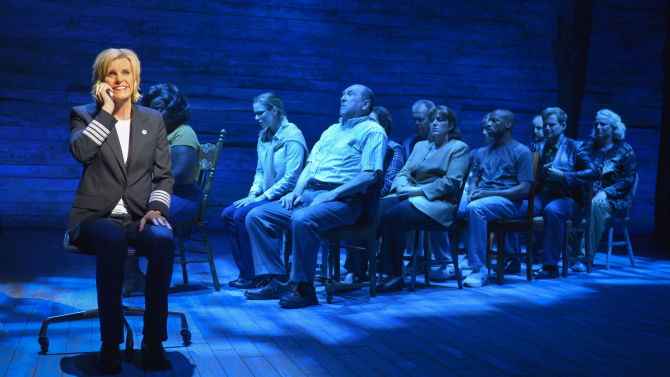
Jenn Colella shines in the role of pioneering pilot Beverley in the new musical Come From Away. (Kevin Berne/ La Jolla Playhouse)

Jenn Colella shines in the role of pioneering pilot Beverley in the new musical Come From Away. (Kevin Berne/ La Jolla Playhouse)

Evocative of the story itself, director Christopher Ashley stages this show with simple elements put together in an amazingly complex way.  A few chairs and tables comprise the set amidst towering onstage trees and partially onstage band.  Despite the already mentioned whirlwind of unfolding action, the story has moments of much-needed cathartic humor.  Chad Kimball and Caesar Samayoa play a number of these moments to great effect as Colin 1 and Colin 2.  No-nonsense Canadian humor comes from Petrina Bromley—a real-life Newfoundlander!—as Bonnie and Astrid Van Wieren as Beulah.

The least consistent moments of the show were—unfortunately—the opening and the closing.  In both instances, the entire company welcomes the audience to “The Rock” through some foot-stomping, heel-dropping, “We’re a strong community” kind of choreography.  Though it means well, the staging is reminiscent of “It’s a Bitch of Living” from Spring Awakening.  The stomping of a bunch of adults in polos and mom jeans seems out of place.  Particularly given how nurturing and generous the audience sees these people throughout the rest of the show, the opening number shows the citizens of Gander in an angrier light than we see them throughout the rest of the show.  It evokes strength, perhaps, but my eyes were wide and concerned on both occasions.
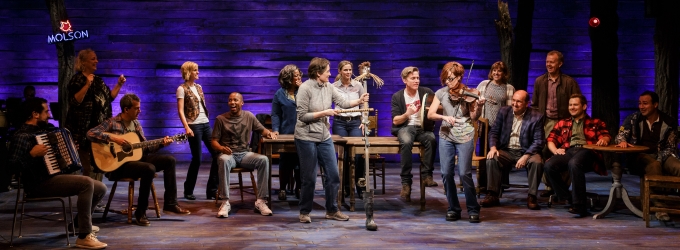
The company of Come From Away--along with the ugly stick--complete the ritual for becoming a Newfoundlander in "Screech In." (Kevin Berne/ La Jolla Playhouse)

The company of Come From Away–along with the ugly stick–complete the ritual for becoming a Newfoundlander in “Screech In.” (Kevin Berne/ La Jolla Playhouse)

The rest of the time, however, my eyes were pooling.  In fact, with each aspect of the story, I sustained a level of “about to cry” so long that I left the theatre with a headache.  But the pain was to the company’s credit.  The extraordinary generosity of ordinary people over the course of five fateful days in September 2001 create an incredible emotional journey for the audience.  Whether or not the audience leaves feeling uplifted by the human spirit—which I did—the show unearths our own memories and our own reactions to this national tragedy.

On September 11, 2001, I was at home in Belleville.  I was painting my bedroom closet mustard yellow.  I turned on the radio to Y98, and went about my work.  As I set up my work space only half-heartedly listening, I realized that what I was hearing wasn’t a St. Louis traffic report.  “No one is getting in or out of Manhattan,” came the voice, much more grave than normal for a morning radio show.  Honestly it took me another moment or two before figuring out that something had happened—something very serious.  I went downstairs to the television and flipped on the Today Show.  Before I could even understand all the images that I was seeing, I watched—in real time—as Flight 175 hit the second tower.  It was horrific. 

 I was about to start my junior year of college studying abroad at my university’s London campus.  Because of our term schedule, I was not leaving until the first of October.  Whether I would be able to go at all was in serious question, because no one knew what was going to happen next.  Would there be more attacks?  Would we retaliate?  My friend who was scheduled to study in Edinburgh was kept home.  I did study in London that term, but it was not without trepidation on the part of my parents. 

 How did you experience the events of September 11, 2001.  Share your story by commenting below.

‘Bright Star’ Shines at Old Globe

San Diego Premieres Steve Martin’s New Musical

bright-star-680.jpg.pagespeed.ce.tm8rzHzik6

In his program note, Old Globe Artistic Director Barry Edelstein calls Bright Star a “great yarn with a heart as big as a mountain and a soul as deep as the sea.”  A “yarn” proves to be an apt description for this show, because the characters in this completely new bluegrass musical weave their story in a lovely, homespun way.  The creators set about knitting that story using the Broadway formula, but—doing so without customary Broadway-style flash—the audience discovers they have invested in the story without knowing they have fallen for the usual tricks.  After an hour of this knitting, the feeling when the houselights come up for intermission is as if the audience discovered they were suddenly wearing sweaters they hadn’t been donning at the top of the show.

Watching this bit of handiwork on stage is a treat.  The work is the Old Globe’s fifth dramatic collaboration with funny man, actor, playwright, banjoist, songwriter Steve Martin over the last two decades, and the theatre has been involved with Bright Star for the past two years.  The piece underwent the workshop process in February and March in New York; now, in October, it receives a full and proper stage treatment.

This slideshow requires JavaScript.

As for the show itself, the story opens on a young veteran making his way home to North Carolina immediately following World War II.  A.J. Shively brings an exuberance to the character of the young soldier, Billy Cane.  At the outset, Billy appears to be the main protagonist; he sets out to become a writer upon his return to civilian life.  His storyline, however, is eclipsed quickly by that of Alice Murphy, his editor.  Throughout the show, the story jumps like a handy game of hopscotch between Miss Murphy in 1945 and her younger self in 1923.  We enjoy Billy’s story arc, but we actually invest in Miss Murphy’s.  Carmen Cusack shines bright as a…well, er—star—in the role of Alice Murphy.  Aside from the expected challenges of portraying the same character 22 years apart in back-to-back scenes—which she accomplishes seamlessly—her voice is particularly suited for delivering both the folksy joy as well as the aching melancholy that the bluegrass score demands at different times.

One such moment of aching melancholy is the second act number “I Had a Vision.”  Though the score overall is quite tuneful, this number—shared by Miss Cusack and Wayne Alan Wilcox who plays Alice Murphy’s teenage flame, Jimmy Ray Dobbs—is the most poignant song in the show.  For anyone in their mid-thirties to mid-forties whose present life is different than their twenty-year old self had planned, this song is especially heart-breaking.  By this point in Act II, that same audience who realized they were wearing sweaters look down to discover that somehow the cast has also sewn on buttons and has closed the garment around them.

The garment is plenty comfortable.  Steve Martin—as composer and book writer this time—teams with lyricist Edie Brickell to fashion a bluegrass score that is at times straight up Appalachian hoedown (“Whaddya Say, Jimmy Ray” and “Another Round”) and at other times more of a show tune sensibility (“A Man’s Gotta Do” and the aforementioned “I Had a Vision”).  The cast generally balances bluegrass and Broadway quite well, aided greatly by the orchestra that includes banjo (of course), guitar, mandolin, and fiddle.  While avid musical theatre ears might harken to shows like Smoke on the Mountain, the instrumentation doesn’t seem out of place for a casual theatre-goer who has a Pandora playlist that includes Mumford & Sons.  Efforts to resist toe-tapping are worthless.

Putting the orchestra in the frame of a house, director Walter Bobbie involves the musicians in a charming way without being too gimmicky.  As scenes shift, the actors wheel that shack around the stage like Dorothy’s house.  The audience never questions the band’s onstage presence; they are totally at home in the thick of the action.  On the subject of scenery and staging, Bobbie employs the kind of devices that leave the majority of the work to the imagination.  With this kind of Our Town-esque responsibility, the director charges the actors to transform chairs and crates into a train in one moment and a star-lit glen in another.  The sensibility is a bit more Peter and the Starcatcher than Our Town, but it is of the same lineage.  In Bright Star, the production value always bows in deference to the story, which is the right approach in this instance.

As stated before, the possibility that Mr. Martin and Ms. Brickell might tailor this piece further following the San Diego run is an exciting prospect.  The creators might consider rounding out Act II with a few additional numbers or judiciously-placed reprises.  For example, Miss Murphy’s employees, Daryl Ames and Lucy Grant—played hilariously by Jeff Hiller and Kate Loprest—could stand to have a number in addition to their part in the lackluster expositional number “My Wonderful Career.”  Dora—the slightly daffy sister played by Libby Winters—needs more material to connect the events from Act I to her raucous Act II romp, “Another Round.”  Lastly, because Act I ends in a kind of lean-forward-in-your-seat, eyes-wide-open manner, Act II opens with the reassuring “Sun’s Gonna Shine” to release the collective tension.  But the song speaks with so much hope that it practically begs for a reprise at the end of Act II.  Martin and Brickell use a reprise of “I Had a Vision” instead—which is effective and moving—but the moment could benefit from some musical quoting of “Sun’s Gonna Shine.”  No doubt, the creators feel they have a complete and streamlined story, and again, in this instance, snappy storytelling is probably the best choice.  But the audience—happily on board for the story—would probably permit a few detours.

The Old Globe should be commended for this collaboration with Ms. Brickell and Mr. Martin as well as with director Walter Bobbie, choreographer Josh Rhodes, music director Rob Berman, and the team of designers.  They have woven a story that feels good and that hopefully will parade around for awhile before it goes in the cedar chest.

Carmen Cusack as Alice Murphy and Wayne Alan Wilcox as Jimmy Ray Dobbs with the cast of the world premiere of Bright Star, a new American musical with music by Steve Martin and Edie Brickell, lyrics by Brickell, book by Martin, based on an original story by Martin and Brickell, and directed by Tony Award winner Walter Bobbie, Sept. 14 - Nov. 2, 2014 at The Old Globe. Photo by Joan Marcus.

Carmen Cusack as Alice Murphy and Wayne Alan Wilcox as Jimmy Ray Dobbs with the cast of the world premiere of Bright Star, a new American musical with music by Steve Martin and Edie Brickell, lyrics by Brickell, book by Martin, based on an original story by Martin and Brickell, and directed by Tony Award winner Walter Bobbie, Sept. 14 – Nov. 2, 2014 at The Old Globe. Photo by Joan Marcus.

Edited:  March 24, 2016

Create a free website or blog at WordPress.com.